Inhaled Insulin (Afrezza) vs. Injections: Is It Actually Faster?
Download MP3Did you know that you can inhale insulin? You sure can. And guess what? It's not new. It's been around since 2014. It's called Afrezza. But as the years go by, we keep learning more about it: how to use it, how to use effectively, and how to get the most out of it. And we're going to talk about all those things on this edition of the Taking Control of Your Diabetes Podcast.
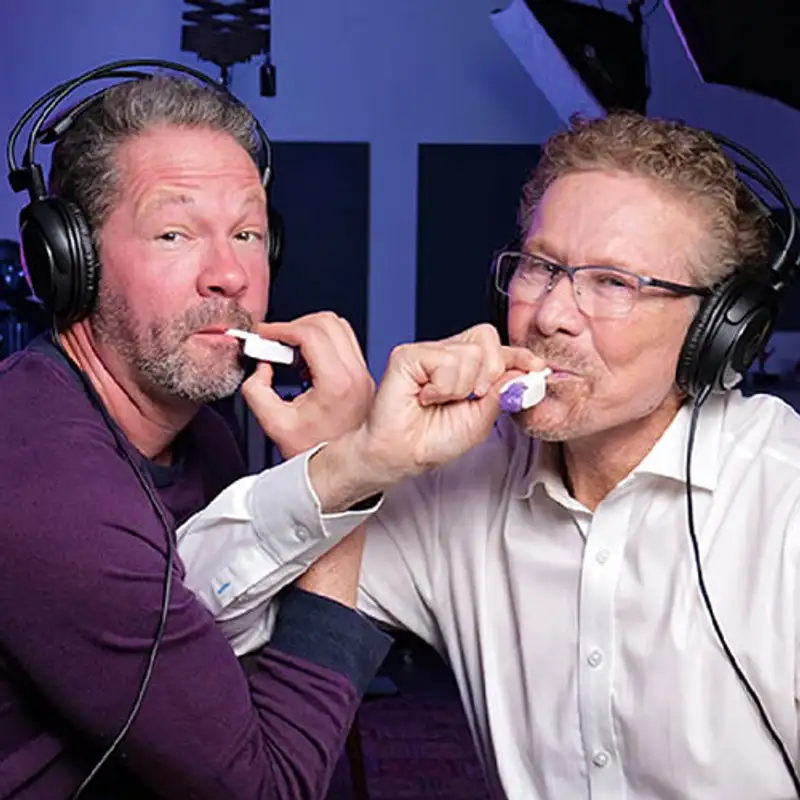
I'm one of your hosts, Dr. Jeremy Pettis, and he is Dr. Steve Edelman, and we are both endocrinologists, both living with type 1 diabetes since we were 15. We work at TCOYD that Steve founded about 30 years ago—in 17 days we just celebrated our 30th anniversary. So on this topic, it's just Steve and I. So settle in.
We're going to talk about Afrezza, and Steve and I have a long history with this medication. We got our first prescription in 2014 when it came out. We've kind of been on this journey of how to learn to dose it, the timing, all those kinds of things. But for you people that it's the first time hearing about it or you don't really know much about it, it's an inhaled insulin. We've done many videos about this at TCOYD. And the benefits are not really that it's inhaled. It's nice to not have to give yourself an injection, I suppose, but the benefit really is how fast it is.
Rapid onset and it gets out of your system very, very quickly. We talk about all the time how insulin is so slow. Even our "rapid-acting" insulins, they take 30 minutes to start showing up in your bloodstream to do anything. They peak in about two hours. They hang around for 4 hours. That's not even close to what the beta cell that makes insulin naturally does. It can release insulin, get into your system in seconds, and get out in minutes. Afrezza is much closer to that. So Afrezza actually peaks in about 15 or 20 minutes, and then a little bit longer than that, but then it hangs around maybe 90 minutes max. So it really is kind of this rapid-on, rapid-off. Perfect for bringing down those stubborn highs. You're hanging on a blood sugar of 250; you can finally bring it down, get on about your business, or inhale it right when you eat. And it does work fast enough that you can actually take it a lot of times right when you eat. So, it's a very convenient, very sharp tool for addressing particularly post-meal high blood sugars.
Yeah, that was a good review, Jeremy. And it's approved for both type one and type two. In type ones, anybody with type one out there talks about those sticky highs. Once your blood sugar gets up, you give yourself some more subcutaneous insulin, nothing happens. You give more and then crash. And so, as you said, this insulin peaks so much faster and gets out of the system. I almost feel that getting out quickly is as beneficial as it starting to get in your system quickly because you avoid those delayed hypoglycemias. And it's much closer—not the same—as a normal individual that secretes their insulin right into the bloodstream. But it's a lot better.
You know what, Jeremy? I think you and I have been promoting Afrezza for a long time because we use it, we like it, and I think now the tide is starting to turn where more and more people are using it. Physicians previously didn't know about it and many still probably don't. But I think as the word gets out that this can really make a difference in diabetes control, it's going to be used more.
I would say humbly that outside of the company, you and I have done more for this drug than any two people on the face of this earth. We talk about it. It's underutilized. It's really effective, but it has been an interesting journey. So, when it first came out, they really didn't know how to dose it. And so, they said whatever you take for mealtime insulin, let's say you take four units of Humalog, it's a 1:1 conversion. So, you would take four units of Afrezza. And kind of the punchline here is we've learned you need to take probably about twice as much, sometimes a little bit more. So instead of taking four units of Afrezza, you would need to take eight units. And it's not that you're actually taking more insulin. It's just that they didn't have that conversion right. And that really shot them in the foot in terms of launching the drug.
I'll tell a quick story because when it literally first came out, Steve, I think you prescribed it for me and we had our fellows conference, which is a conference where we get the trainees around. We talk about diabetes cases and Steve and I did our first inhalation of Afrezza in front of them to show them how you do it, how it works, things like that. And I took four units of Afrezza and I ate half a sandwich, which would be kind of like the right dose for me for Humalog or Novolog. So, I took my Afrezza, I ate my half a sandwich, and an hour or two later, my blood sugar was like 250. And I said, "Man, this stuff doesn't work." And I put it in a drawer for honestly like at least a year, maybe even longer, because I was like, "This stuff doesn't work." And it wasn't that it didn't work, it's just that I didn't take the right dose. And that happened so often that, obviously if you're off by a factor of two, I should have taken eight units. That's taken a long time to kind of figure that out. And we're finally there now.
Yeah, we'll talk about the timing as well, but as everyone on insulin knows, you should take your fast-acting insulin at least 20 minutes before, and if your blood sugar is elevated even longer. With Afrezza, because it works so fast, you take it at the time of the meal. But let's get back to the dose. The folks at MannKind did a couple of studies, one of them called the INHALE-3 study where they actually looked at what is the appropriate conversion from sub-Q insulin to inhaled insulin. And it turns out that 1:2 is just a starting point. So one unit of sub-Q insulin would be two units of Afrezza. But it turns out that many patients need 1:2.5 or 1:3. So if you take five units of fast-acting insulin, you would take the closest thing to 15 units of inhaled insulin. We know the cartridges are 4, 8, and 12. So you just kind of get to the closest equivalent dose. And so it's really 1:3, Jeremy. And you probably realize that because you've used it yourself. A lot of times when you and I always laugh about when the blood sugars start to come down, we educate our patients: when you see two arrows coming down after using Afrezza on a high blood sugar, don't worry, it's like exit stage left. All of a sudden your arrows turn to one arrow, one diagonal, and then flat. So it's really quite an amazing drug and I don't think I've gotten low on Afrezza maybe once in using it for many, many years. So it's really safe that way.
Yeah. So the company is going to the FDA to officially change their label. So right now it says 1:1, but I would say if you're starting, start with 1:2. That's kind of a good safe starting conversion and then you can go from there. And we're belaboring this because this is so important to maximize these benefits. You got to get the dose right. And it's like you said, we've all been there. Your blood sugars are 250. You take two units, nothing happens. You take two more units, nothing happens. I'm talking about through your pump or whatever, and then you say, "F it." You take your rage bolus, you take 10 units, and then guess what? You completely crash. The Afrezza comes down quickly, gets out of your system. There's really nothing like it. And then, liberating your diet. I always talk about acai bowls and these crazy high carb things that I would never dream about eating—and I don't eat them very much even though you love to give me crap about my diet—but like you have a tool that can actually fight kind of these high carb things like pasta. Like you know all about three donuts in 20 minutes in our donut challenge; we used Afrezza.
All right, so knowing the dose is so important; that 2:1 ratio is important to keep in your head. Number two is timing. And you're right. I would say the thing I spend the most time in clinic talking to patients about with regular insulin, subcutaneous insulin, is pre-bolusing. You got to take your insulin 20 or 30 minutes before you eat because it takes that long to work. And if you don't do that, you're always going to kind of "lose" against that food because you're going to spike. But people, it's difficult. They don't know how much they're going to eat. They don't like taking that full bolus. So it's a whole conversation. With Afrezza, the vast majority of the time you can take it right when you eat. Now, if your blood sugars are high, above 180, you might want to wait 10 minutes or something. So, like a little bit of a pre-bolus. And if you're on the lower side, you can actually inhale it after you start eating if you're in the 90s, something like that. So, trial and error. But the idea here is that we finally have something that you could actually take right when you start eating. And it works. It's kind of up to the fight in terms of how fast carbs are absorbed. That's how fast Afrezza is working.
Yeah. Because it gets out of your system so fast, depending on what you're eating. If you're eating a lot of protein or you're eating a lot of food, you might need what you and I like to call a follow-on dose. Call it a correction dose. And you can actually give a correction dose within 60 to 90 minutes of your first inhalation because it gets out of your system quickly. So that may be a normal finding or a normal correction dose that you may need depending on what you eat, how much you eat, and you can just do it pretty quickly even if your blood sugar is in the pretty normal range.
Yeah. We actually advise adamantly for people not to do that when they're on Humalog or Novolog. Wait 2 hours after your last bolus, see the effect. With Afrezza, it does get out of your system so quickly. So you can do these more frequent taps, Steve. You do your best to get the initial dose right. And if your blood sugars start going up an hour or two later, you can take a little four more units or whatever, so you can just kind of have, like I said, a sharper tool, more precise kind of control over your blood sugars.
I think sharper tool is a great word. I really like that because if you look at the non-diabetic, the insulin goes right from the pancreas into the circulation and it's rapid-on, rapid-off. Afrezza is not quite that fast, but it's way closer to physiologic insulin secretion than sub-Q insulin. The other thing I should mention, if we're talking about doses, is that they clearly showed in these studies if a person's blood sugar was over 140 at bedtime, they took a four-unit cartridge. And you think, oh my gosh, you're going to give insulin at night, you're not even eating. But because of the rapid-on, rapid-off, and above 140, it was super safe. And these patients woke up with a much better fasting blood sugar.
Yeah, that's awesome. The other kind of big picture comment I wanted to make about Afrezza is Steve kind of quickly mentioned that they come in these blocks. You can get a 4-unit cartridge, an 8-unit cartridge, a 12-unit cartridge. So yes, you can't do your 1.67 units or whatever you can get through your pump, but I actually think there's an advantage there that it makes you think more big picture about what you're eating. So when I sit down to eat and I'm using Afrezza, it's less about how many exact carbs versus is this kind of small, medium, large. Is this a four? Is this an eight? Is this a 12? And you kind of put it in those buckets. And I think you can do away with a little bit of the precision because the rapidity of the insulin is so quick. It kind of makes up for errors, if that makes sense. So as long as you take something at the beginning and you can kind of fine-tune it, it makes it again a little bit more conceptual. Some people will say they move away from units—4, 8, 12s—to "I just do a blue, a green, a yellow." So it kind of simplifies diabetes a little bit.
Yeah, I've always thought you were a concrete thinker like that. For you non-scientists out there, the medical phrase we use is pharmacokinetics and pharmacodynamics. Pharmacokinetics just shows how fast the insulin appears and disappears in the blood. And dynamics is how fast the glucose will come down with an inhalation of Afrezza. So it's quite a unique insulin, not only like you said in terms of the route of delivery, but it's really the time course of action that makes it a very unique drug and closer to physiologic insulin secretion. It's a much sharper tool.
Yeah. So let's talk kind of globally about hypoglycemia next. So since the conception of Afrezza, what they've consistently shown is that people actually have less hypoglycemia, specifically what we call delayed hypoglycemia, like 2 to 4 hours after eating. And that makes sense, right? Because most of the Afrezza is out of your system. So you're kind of matching the insulin needs to when the carbs are coming better rather than having this dose of Humalog or Novolog hang around for four or five hours and cause lows. That also pertains to exercise. There are comments here on these notes that yeah, if you're going to go exercise, what you want to do when you go into something that's going to lower your blood sugar like exercise is you want essentially no insulin on board. If you go for a cycle and you got two units on board, you're probably going to go low. So Afrezza can help with that because you could take it a couple of hours before you exercise and you can be very confident that that's out of your system by then.
Yeah. And I think that makes life more convenient. You don't have to wait around. Nothing worse than subcutaneous insulin on board before you go exercise. The muscles will just suck up the glucose in the blood due to the insulin around and people will get low.
Yeah. So that's very convenient, I think. You know, and we all hate—I'm sure you've been there, Steve—where you kind of under-bolus for, let's say, lunch because you know you're going to exercise and you go up to a blood sugar of 230, but then your exercise gets delayed and you're just kind of high the whole time. And then maybe you don't even end up exercising. You're like, "I was just my blood sugar was like high for hours for no real reason." Just kind of another tool in the toolkit of, "Hey, I could take some Afrezza, address that lunch meal, and then go exercise safely."
Yeah. Well, I can tell everyone how I used it in the last 30 minutes. We did a filming this morning about foods that are good for you and foods that aren't good for you. So, as part of the example of foods that are not good for you, we had a bowl of Trix cereal with milk. And to me, I couldn't just throw it out. Like it's just sacrilegious to waste Trix cereal. For those of you that are listening, it is my favorite cold cereal. As a kid, I ate the whole bowl. I gave up the miniature Cobb salad I got from a local and I was 247 with two arrows straight up. I took 16 units and so far I know that... Yeah, now I am 242 with a trend arrow diagonal down.
So, and you just took that like 10 minutes ago. So, for something to turn the tide on like a super high raging high like that is pretty impressive.
And I should have just... I should have done it before I ate the Trix.
Ideally, you should listen to this podcast. We got all kinds of tips for you. All right. So, speaking of tips, tips for inhaling it. Steve, do you want to walk us through that?
Yeah. There's a lot of talk about people's best way of taking it. The first thing for sure, you got to take it out of the fridge for 30 minutes. What I do when I go around town, I have a little Ziploc bag with some of the cartridges in each dose's content and I have it in a Ziploc bag and so I keep those out for at least two weeks and I use them. They're good. I don't expose them to heat, but I make sure that I don't just take it out of the fridge and inhale it 'cause then you can get little clumps and then that can increase your chances of coughing. So, that's number one.
Well, I will say the cartridges come in these little... what would you call those, Steve? Like you kind of punch them out of that plastic. So the official expiration is that as long as they're in those little punch things, you can have them out of the fridge for a week, and then once you punch them out of the cartridge, they're technically good for 3 days. But as Steve says, he carries them around in a sweaty plastic bag for two weeks and they're still good to go. So, you know, in our practice, we find that these things don't really go bad, but that's kind of what you might hear from your provider or the local rep. So, make sure they're not cold because yes, if they clump it can feel like it gets stuck sometimes. It can make you cough. That's also something when people first start it. That's the main side effect is that people cough. It is a powder. It feels a little odd, a little irritating. So people tend to cough with initiation, but then you look over time that goes down rapidly. So by the end of generally four weeks or the first month, people are not coughing as much. But I tell people to kind of expect it. And importantly, when you inhale and you do cough, you've gotten that dose. So sometimes people say, "I coughed, did I cough it up? Do I need to repeat the dose?" No, it gets in the lungs quickly and just, you know, the cough, it is what it is.
Yeah. But I think the other thing too is the inhalation. Two to three seconds, kind of a brief [inhalation sound] like that.
Yeah. You don't have to act like you're going to blow a house down is the important thing. It's kind of a gentle, smooth pull rather than like this huge suck. And also sometimes like a little bit of water before you inhale can help. Or if you do cough, actually water afterwards is also good. This says "positioning your inhaler to the side of your mouth to reduce coughing." I've never heard that.
Neither did I. And I think that everyone's going to find the way that suits them. Some people never have a cough. I occasionally have a cough, but I think you're supposed to when you snap the inhaler, you tilt it down a little bit...
Yeah. So, you pop the cartridge into the inhaler, snap it down, inhale, and then you throw that cartridge away, and you're good for kind of the next time. I should say the official recommendation is to change out your inhaler every two weeks.
Yeah. Probably don't have to.
Well, let me just say because over time you can get a little of the powder stuck in the inhaler. So you can kind of tap it out, but if you go months with one inhaler, it can get pseudo-clogged. Or I guess you could inhale it and get all that kind of residual. So just every two weeks is probably a good rule. To be honest, what I do is every prescription you get comes with multiple of these inhalers. And by now I just have them all over the place. You know, some in my bag, some in the car, some in my fridge, all that.
And you can tap it on a hard counter like this podcast table and you see a lot of powder come out. And I think that's a good idea to do every once in a while, too, especially if you're a frequent user. And I think, you know, the side of the mouth, I'm not sure where that came from. And the water, I think that's a wives' tale, but I like to use bourbon.
Yeah, bourbon definitely helps. A little bourbon with coughing especially.
So, before we go on, I just wanted to ask you a tiny step backwards in terms of the usage. What if you're on an insulin pump or a hybrid closed loop?
Yeah. So in our clinical practice, Steve and I, we find that this works really well. So actually Steve and I are both on a hybrid closed loop, different systems. And I think it works particularly well. Let's say you do it at the start of a meal. You just don't enter your carbs for that meal. So it kind of is like a wash. You know you're taking the Afrezza to battle these carbs and the pump is kind of none the wiser. Doesn't know that you're doing this. But the pump can help especially let's say after the meal your blood sugar starts creeping up or down, the pump can then kind of adjust up or down to help. So I find that these actually work very well with hybrid closed loops. And along those lines, Steve, there's no wrong way to use Afrezza. I always tell people when they start, stay on whatever you're on. If you're on a pump, you're on shots, whatever, just have Afrezza. Try it to correct a high blood sugar, then maybe try it at the beginning of a meal. And a lot of people will just kind of stop there, use it kind of as needed for these unique situations. But a lot of other people will say, "I love this. I want to do this for every meal, every correction." And you can do that. So, it can be an addition. It can be a substitution. It can be anything along the way.
No, I think you're right. There's a lot of flexibility. And you know, every one of these hybrid closed loop systems have a different algorithm. And I think they all are in part based on the rate of change of glucose and they make adjustments. So if you take Afrezza and your blood sugars start to drop after peaking, the automatic insulin delivery should adjust. And I would say this, that the better the algorithms get, probably the more specific information we'll need to feed the system. For example, I use Loop. It's an open-source automated insulin delivery system and it has a choice if you want to take Afrezza, you can put in "I just took eight units of Afrezza" and it takes into account the rapid-on, rapid-off. So I think as we march along and the sophistication of these hybrid closed loops using AI or whatever, we'll be able to input Afrezza. But like you said, I've never heard of any problems currently.
Yeah. Now the other kind of big news is that currently Afrezza is not approved for kids. Parents ask a lot of the times. But they've done clinical trials, at least one, and the FDA is reviewing this right now. So it's possible that this could be approved for kids in the relatively near timeframe. And that relates back to this dosing because a lot of times the other major thing I heard when this first came out is that four units is the smallest dose and people would say, "Well gosh, that's quite a big dose for me," especially for kids that might be a pretty big dose. But with this conversion of like 1:2 or 1:3, four units is more like one or two units. And so that makes it more accessible I think to more people and help alleviate that fear that this initial dose is too big.
Yeah. I think people freak out when they hear four units. And the other thing too is because of the rapid-off that should also make them feel a little more cautious. But like you said, it's always good to let people experiment when they first get their hands on Afrezza, get their blood sugar above 200 with a horizontal trend arrow and take a hit. And see what happens and you can get an idea of how your body reacts to it.
Right. And that's something we haven't explicitly said, but if you do use Afrezza, really any insulin, you should be on a continuous glucose monitor. But I think particularly Afrezza, because it has such a unique... when it's kicking in, how much it's acting, all those things, you literally need to see it. So yes, you can be on a pump or MDI. I'm kind of indifferent to that, but you absolutely need to be on a CGM.
Yeah. And for you type twos out there, if you're on a GLP-1 or a GLP-1/GIP, there's no issues with using it with those medications because not everyone on these medications do not need insulin. Just depends where you're at in your history of type 2 diabetes. And so, yeah, I can't think of anything where you should not use it. We should mention, Jeremy, that if you are an active smoker or you have pretty reactive asthma or COPD, you should not be using Afrezza. And everyone needs to get their FEV1 incentive spirometry at baseline, at 6 months, and then yearly, which is a quick test, not a full pulmonary function test.
Yeah, so I think the message there is that Afrezza does not cause lung problems. That's been studied for years now, 10 years. However, if you have underlying asthma or an underlying condition, it can exacerbate it. So, the reason that we do this quick what Steve's calling an FEV1 spirometry—you just blow in this little tube, sees how much air you can force out in 1 second. So, the test literally takes 1 second—is really to get a baseline to make sure that you don't have some underlying condition that they didn't know about. And then technically yes, you're supposed to do it at 6 months and 12 months and yearly. But that can definitely be done. But it does remind me that overall, you know, Afrezza is not used I think as much as we would like it to be. So as a result, practitioners can be very maybe fearful of using it or dismissive. So I hear all the time that patients will say, "Hey, I went to my provider and said should I try Afrezza?" and they just have some throwaway comment like, "No, it's not for you," that kind of thing. And I think a lot of that is driven because they don't know how to do the spirometry. They don't know how to educate patients on how to use Afrezza because it is a lengthy conversation you might need to have with patients in a clinic room on how to start it. So if you do get resistance, you politely push back, you can find another provider. Sometimes insurance coverage can be difficult, but it's gotten a lot better I would say over the years. So it might be a little bit more of an uphill lift certainly than just continuing on Humalog or Novolog or whatever it is. But generally, you know, it's worth a fight and I would say it's the rare patient that finds no utility at all. People usually come back with some story: "I like it here" or "I use it all the time" or something in between, but I can't think of a patient that comes back and says "I find no use for it."
Yeah, it's usually a frustration because their own primary care doctor wouldn't refill it or something like that. We should say something about prescribing it. You started to, but there are certain specialists that specialize in dealing with Afrezza and they'll do the dreaded prior authorization for the health care professional. So, without getting into the details, I do think it's important to know that, and you could look at the MannKind website. And the other thing is, I'm not sure if you know this Jeremy, MannKind hired a whole group of people across the country as trainers. So they will actually teach you the ultra-proper technique of taking Afrezza because they want people to be successful and they can work directly with the patient, right?
You know, so like this is just like a pump trainer. Somewhere between device and medication where you know, you can have... I mean we can't train all of our patients on pumps, it takes hours, and this is kind of similar to that. So definitely utilize the companies. And I thought we were going to say about the prescriptions is that for the vast majority of people there's a combo 4, 8, 12 box of Afrezza. So you can get some fours, some eights, some twelves. I always think that's a good place to start and then a lot of times people come back to me and they're like, "Man, I got like a zillion twelves 'cause I never use them. I only use the fours and eights." And then you can change the prescription to be fours and eights or only fours or only eights or whatever you need.
Yeah. No, that's important. There's a zillion different combinations. But I think you and I did a videotape on how to approach your health care professional when you know Afrezza may help you, but they are pushing back. And it's funny, but it's also informative. And I say be your own best advocate. You tell the physician that you want to try it. And if you can be nice about it and just say, "I'd like to try it. I know it's a hassle to prescribe, but I'd like to try it." And then you try it. And I would say take advantage of the trainers. And the other suggestion is you can always mention to your health care professional that if they contacted the MannKind rep, they can give them tips and tricks on how to get it approved easily. But it's probably one of the most commonly turned down medications that we prescribe. And I think that has led to the lack of use that we've seen in the community.
Yeah. And again, it's definitely getting better. I would say for people, go to our website tcoyd.org, just type in Afrezza and we've done a bunch of videos, a bunch of newsletters, you know, we have been talking about this for quite some time. Never done a podcast on it, though. So, I think people are hopefully left with... again, in diabetes, whether it's type 1, type 2, you got to get your system that works for you. Hopefully you found a CGM, a pump, but Afrezza is kind of this other tool that a lot of people don't utilize and it can be really effective. And beyond having a lower A1C or living longer and all those things which are obviously important, I find Afrezza is really good with dealing with the frustration of diabetes when you actually have something that can fix a blood sugar quickly. It can help you eat things maybe that you have been avoiding for years and that goes a long way.
Such a sharp tool. Such a sharp tool, buddy.
Well, hope you guys enjoyed this podcast on this very specific but very important topic. So please make sure to like, follow, share. Please take the time, two seconds to do that, because that really motivates us, keeps Steve and I going. We read all the comments that you guys send and it is our currency to show people that people are listening to this and getting some value out of it. So Steve, as always, this has been fun. Thanks for watching if you're on YouTube. Thanks for listening if you're just on a podcast platform. And we will see and you will hear us on the next one.
Thanks Jeremy.
Thanks Steve.